
‘SMRT long-read’ sequencing
Based on SMRT (Single Molecule Real Time) technology, sequencing on PacBio platforms (notably the Revio and Vega systems) enables the production of very long reads with extremely high accuracy. This approach is ideal for resolving regions of low complexity (repeat regions, heterochromatin), characterising all structural variants, assembling genomes de novo and determining haplotypes comprehensively.
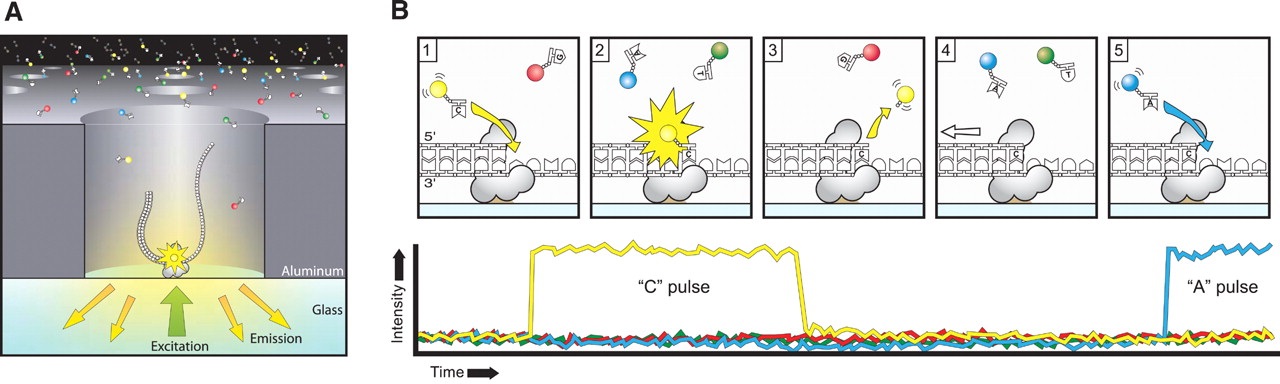
A typical SMRT library is constructed from double-stranded DNA fragments. After end repair, single-stranded adaptors are ligated to them to form a closed-loop structure (SMRTbell), which serves as an anchor point for DNA polymerase and enables circular sequencing (Figure 1).
The insert–adapter–polymerase complex is deposited and immobilised at the bottom of millions of nanometre-scale wells known as ZMWs (Zero-Mode Waveguides). Each ZMW enables real-time detection of the fluorescent signal emitted during nucleotide incorporation by the polymerase (Figure 2).
The technology now relies predominantly on HiFi (High-Fidelity) mode, which is based on circular consensus sequencing (CCS). The polymerase runs through the same circularised SMRTbell molecule several times: HiFi mode (current standard): Repeated runs over the same fragment (typically 15 to 20 kb) enable the correction of random errors and yield individual consensus reads with an accuracy of over 99.9 per cent (Q30+), rivalling short-read sequencing whilst maintaining read length.
Recent innovations: Throughput and scale: The introduction of SMRT Cell 25M chips (on the Revio system) has increased the number of ZMWs by nearly a factor of 3 compared with the Sequel IIe, drastically reducing costs and acquisition time per genome.
- Integrated epigenetics: Measuring polymerase incorporation kinetics now makes it possible to directly identify base modifications (e.g. 5mC, 5hmC) simultaneously with base sequencing, without the need for prior chemical treatment (such as bisulphite).
- On-board analysis: The conversion of raw data into high-fidelity, high-precision sequences is now carried out directly in real time by the sequencers’ on-board processors.