

Indirect mapping of chromatin accessibility sites: MNase seq
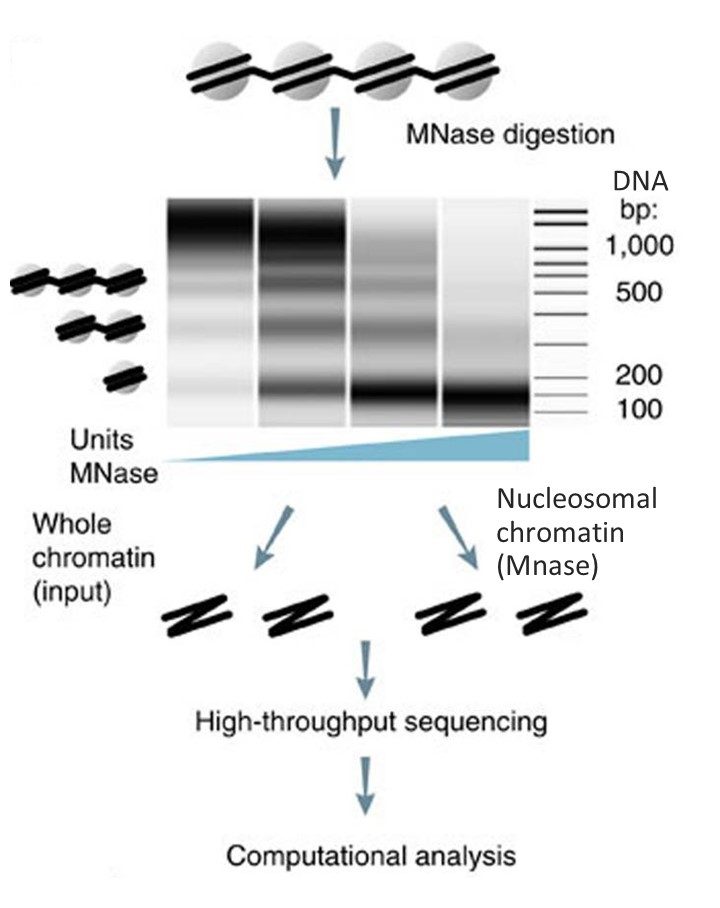
Nucleosome arrangement is an important aspect of chromatin organisation, with direct implications on gene regulation. The usual nucleosome mapping technique is based on micrococcal nuclease (MNase) digestion, which preferentially targets free DNA (unprotected by proteins). When compared to a control sample that has not been MNAse-digested, chromatin accessibility sites can be indirectly determined.
To avoid any re-conformation of the chromatin during its extraction or fragmentation, crosslinking is recommended using formaldehyde. The MNase enzymatic digestion is a critical step in the protocol, as concentrations and incubation times should be chosen so that all classes of nucleosomes can be isolated and mononucleosomal DNA fragments of 200bp to 500bp can be obtained without leading to DNA damage (see figure). . The DNA-histone complexes are then cleaved and the purified DNA can be processed for sequencing (Mieczkowski et al. 2016).

Rubriques associées
- Small RNA Sequencing
- TAPS/TAPSβ
- Enzymatic Methyl-seq (EM-seq™)
- Long-read sequencing of native methylated DNA and RNA
- DNA binding sites map : CUT & RUN vs CUT & Tag
- Cis and Trans Chromatin Contact Mapping: Hi-C
- RRBS seq
- EPIC chip Illumina
- Methylation-dependent modification, Illumina 5-base protocol
- Mapping Chromatin Accessibility Sites: ATAC-seq
- Mapping of RNA-protein interaction sites: CLIP seq
- Mapping of DNA-protein interaction sites: CHIP seq
- Mapping of DNA epigenetic marks: MeDIP
- BiSeq