

Mapping Chromatin Accessibility Sites: ATAC-seq
ATAC-seq (Assay for Transposase-Accessible Chromatin using sequencing) is a leading methodology for identifying open chromatin regions, positioning nucleosomes, and analyzing transcription factor (TF) binding.
The principle relies on an hyperactive Tn5 transposase to simultaneously fragment and tag accessible DNA (tagmentation). While fast and sensitive, the protocol requires careful execution to preserve native chromatin structure.
The advent of scATAC-seq (single-cell ATAC-seq) marked a major breakthrough by scaling this approach to the single-cell level. By capturing cellular heterogeneity within complex tissues, scATAC-seq maps the epigenetic landscapes of rare subpopulations and reconstructs cell differentiation trajectories.
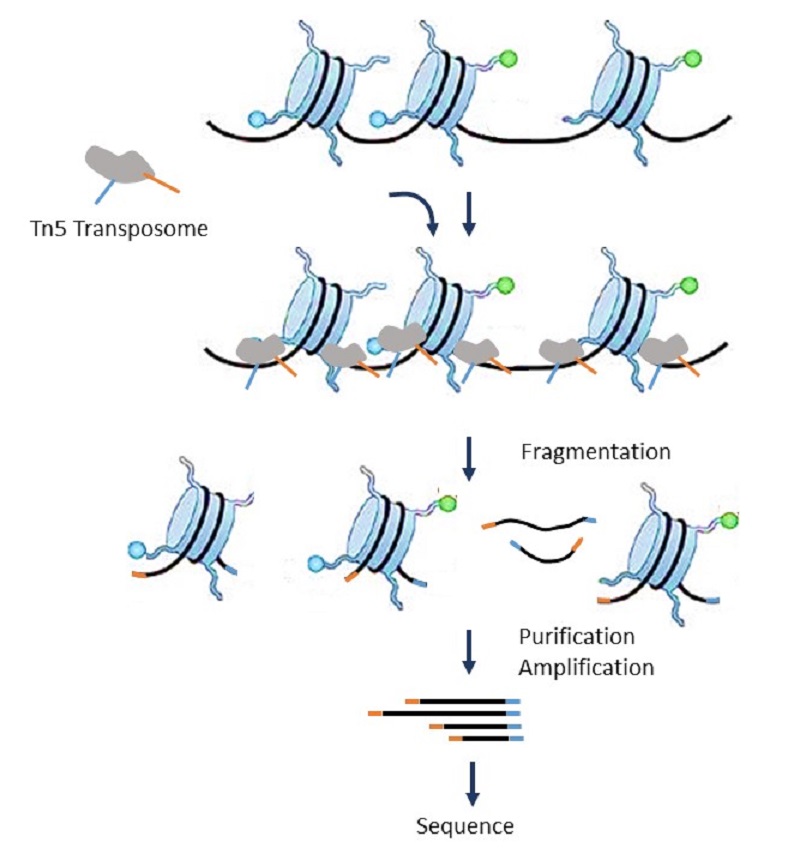
More recently, single-nucleus multi-omics integration (multi-seq) has pushed boundaries further. Technologies combining scATAC-seq and snRNA-seq (single-nucleus RNA sequencing) within the exact same nucleus allow researchers to directly correlate chromatin accessibility with gene expression. These joint approaches clarify the functional links between regulatory regions (enhancers, promoters) and target gene transcription, delivering an integrated epigenomic and transcriptomic profile with unprecedented resolution.
Update: Aug 2026
Rubriques associées
- Small RNA Sequencing
- TAPS/TAPSβ
- Enzymatic Methyl-seq (EM-seq™)
- Long-read sequencing of native methylated DNA and RNA
- DNA binding sites map : CUT & RUN vs CUT & Tag
- Cis and Trans Chromatin Contact Mapping: Hi-C
- Indirect mapping of chromatin accessibility sites: MNase seq
- RRBS seq
- EPIC chip Illumina
- Methylation-dependent modification, Illumina 5-base protocol
- Mapping of RNA-protein interaction sites: CLIP seq
- Mapping of DNA-protein interaction sites: CHIP seq
- Mapping of DNA epigenetic marks: MeDIP
- BiSeq