

RRBS seq
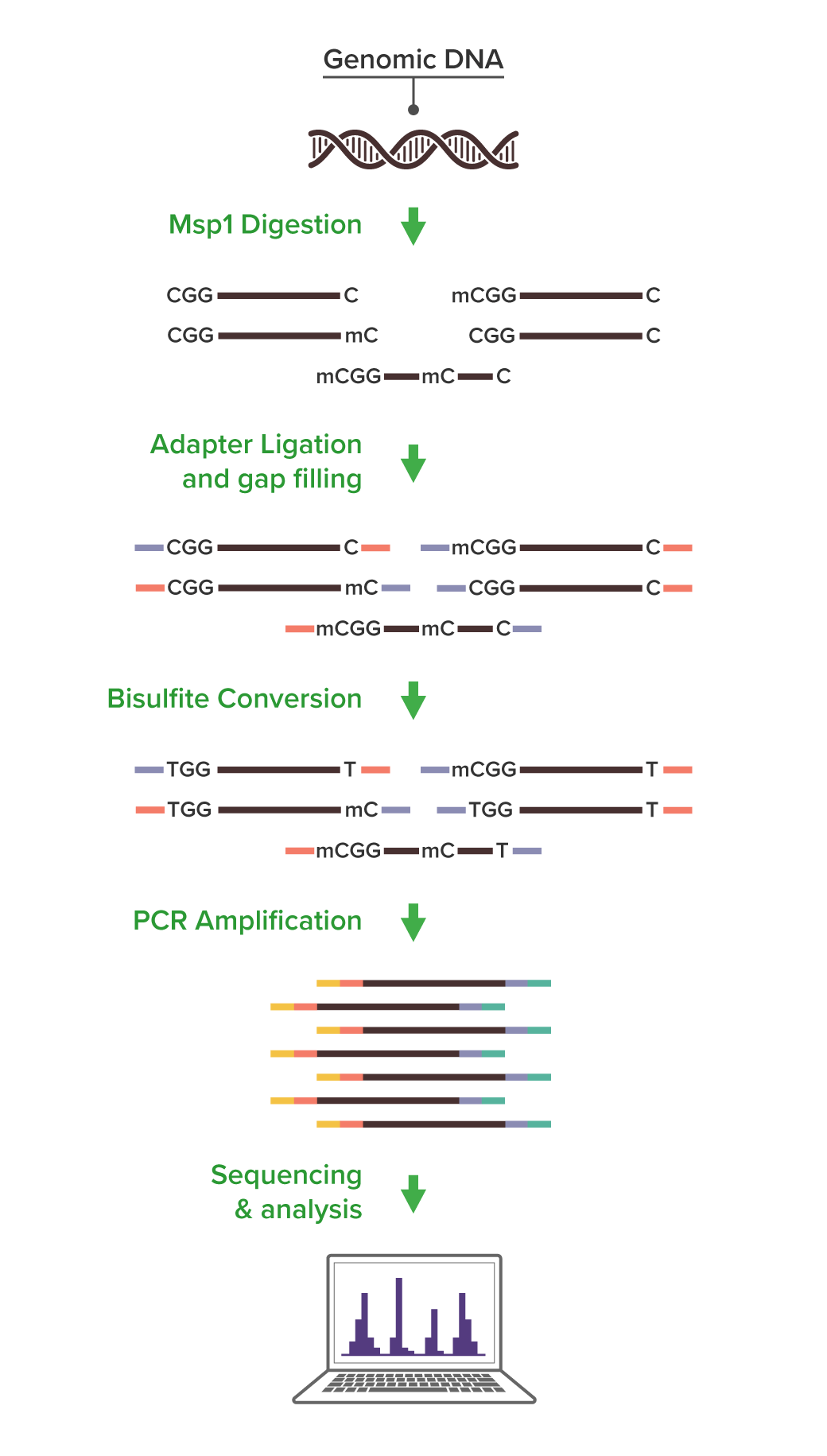
Reduced representation bisulfite sequencing (RRBS) is a cost-effective, high-throughput laboratory technique used to analyze genome-wide DNA methylation at single-nucleotide resolution. By combining restriction enzyme digestion with bisulfite conversion, RRBS enriches areas with high CpG content—such as promoters and CpG islands—reducing the required sequencing volume to a small fraction of the genome. https://www.nature.com/articles/nprot.2010.190
Genomic DNA is cut using a restriction enzyme like MspI, which recognizes and cleaves specific CCGG motifs regardless of their methylation status. Fragments are sorted by size (typically capturing small fragments around 90–220 bp) to concentrate the library on CpG-dense regions. Sodium bisulfite treatment converts unmethylated cytosines into uracil (read as thymine during sequencing), while methylated cytosines remain protected and are read as cytosine. Libraries are then sequenced using platforms like Illumina, and the reads are aligned to a reference genome to calculate methylation percentages.
It requires only 10% to 20% of the sequencing data volume compared to whole-genome bisulfite sequencing (WGBS) and captures the majority of promoters, gene bodies, and CpG islands where critical regulatory methylation occurs but a major drawback is that the coverage is limited; roughly 5% to 10% of all CpG sites in mammalian genomes, missing regions outside the restriction sites.
Update: Aug 2026
Rubriques associées
- Small RNA Sequencing
- TAPS/TAPSβ
- Enzymatic Methyl-seq (EM-seq™)
- Long-read sequencing of native methylated DNA and RNA
- DNA binding sites map : CUT & RUN vs CUT & Tag
- Cis and Trans Chromatin Contact Mapping: Hi-C
- Indirect mapping of chromatin accessibility sites: MNase seq
- EPIC chip Illumina
- Methylation-dependent modification, Illumina 5-base protocol
- Mapping Chromatin Accessibility Sites: ATAC-seq
- Mapping of RNA-protein interaction sites: CLIP seq
- Mapping of DNA-protein interaction sites: CHIP seq
- Mapping of DNA epigenetic marks: MeDIP
- BiSeq