

Regulation of Gene Expression
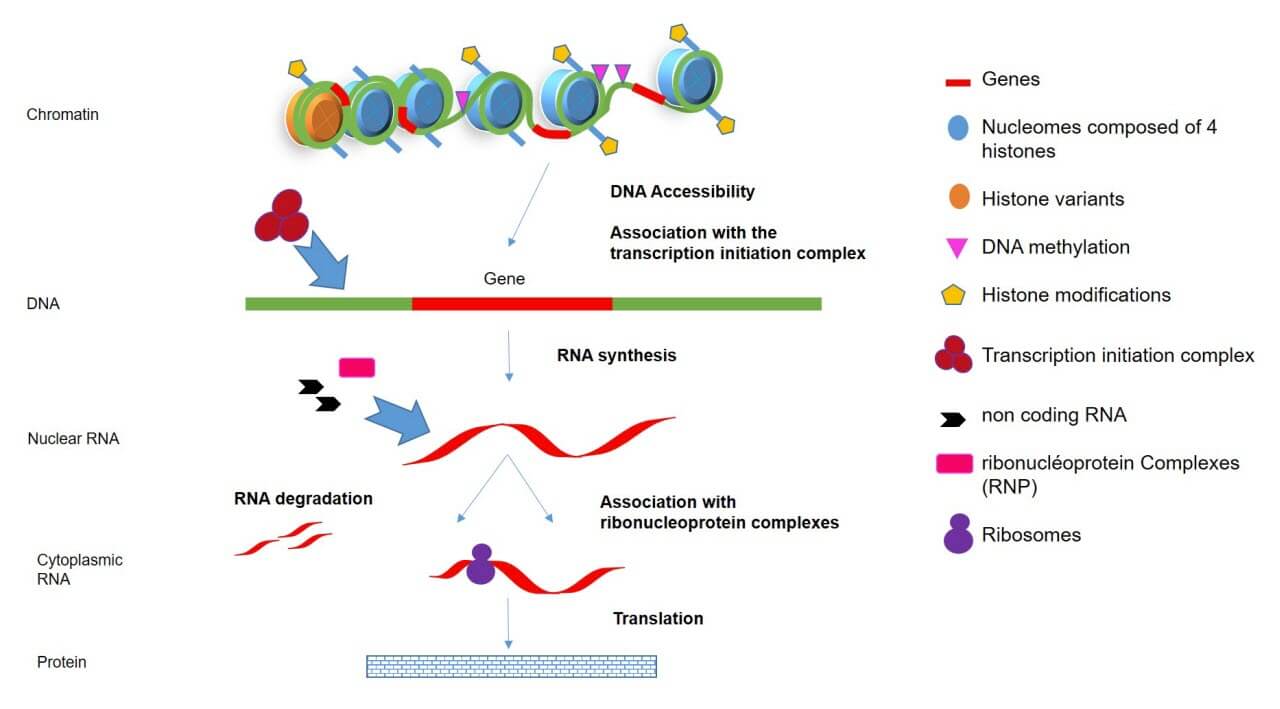
The regulome refers to the ensemble of cellular regulatory components and networks controlling the expression of genes, their isoforms, and protein dynamics, according to subcellular localization, tissue state, developmental stage, and pathology. Recent technological innovations have profoundly enriched our understanding of these mechanisms:
- Chromatin Accessibility and 3D Conformation: DNA accessibility relies on nucleosome dynamics and histone modifications. Single-cell omics technologies (scATAC-seq) and chromosome conformation capture methods (Hi-C, Micro-C) now enable the mapping of three-dimensional genome architecture and enhancer-promoter interactions at single-cell resolution.
- Epigenomics and Nucleic Acid Modifications: Beyond classical cytosine methylation (5mC/5hmC), long-read sequencing (PacBio, Oxford Nanopore) now allows direct and simultaneous detection of multiple epigenetic modifications on DNA and RNA (epitranscriptomics, e.g., m6A) without bisulfite conversion, revealing unprecedented regulatory complexity.
- Transcription Factors and Functional Genomics: Transcription factors bind to specific sequence motifs. High-throughput genetic screening approaches (CRISPR-Cas9, CRISPRi/CRISPRa) combined with single-cell sequencing (scRNA-seq) and genomic AI models now make it possible to functionally characterize and predict the impact of non-coding regulatory elements on a large scale.
- Ribonucleoprotein Complexes and Post-Transcriptional Regulation: RNA-protein interactions (RNPs) govern splicing, maturation, and RNA stability. Spatial genomics and in situ RNP complex capture technologies illuminate the compartmentalization and dynamics of these interactions within biomolecular condensates and cellular granules.
- Non-Coding RNAs and RNA Therapeutics: In addition to microRNAs and small RNAs regulating translation and mRNA degradation, the discovery of diverse long non-coding RNAs (lncRNAs) and circular RNAs (circRNAs) has significantly expanded the regulome. The rise of RNA therapeutics (modified mRNA, antisense oligonucleotides, siRNA) demonstrates the ability to directly manipulate these networks.
All these dynamic mechanisms are continuously shaped by environmental factors (exposome: nutrition, pollutants, stress, aging, medications), leaving lasting epigenetic imprints.
Rubriques associées
- Small RNA Sequencing
- TAPS/TAPSβ
- Enzymatic Methyl-seq (EM-seq™)
- Long-read sequencing of native methylated DNA and RNA
- DNA binding sites map : CUT & RUN vs CUT & Tag
- Cis and Trans Chromatin Contact Mapping: Hi-C
- Indirect mapping of chromatin accessibility sites: MNase seq
- RRBS seq
- EPIC chip Illumina
- Methylation-dependent modification, Illumina 5-base protocol
- Mapping Chromatin Accessibility Sites: ATAC-seq
- Mapping of RNA-protein interaction sites: CLIP seq
- Mapping of DNA-protein interaction sites: CHIP seq
- Mapping of DNA epigenetic marks: MeDIP
- BiSeq