

Methylation-dependent modification, Illumina 5-base protocol
Traditionally, methylation analysis of cytosine at position 5 (5-mC), predominantly occurring within CpG dinucleotides, relied on sodium bisulfite conversion (Bi-Seq). Despite its widespread use, this approach suffers from significant drawbacks: it causes severe DNA degradation, reduces sequence complexity, and fails to easily discriminate between 5-mC and 5-hydroxymethylcytosine (5-hmC).
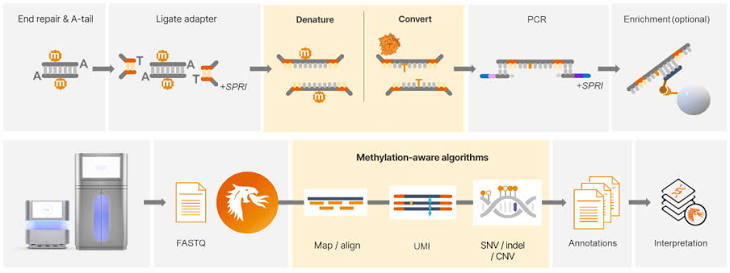
To overcome these limitations, Illumina’s “5-base” sequencing protocols integrate the direct or enzymatic detection of epigenetic modifications into standard high-throughput sequencing workflows. This protocol relies on selective enzymatic conversion rather than harsh chemical treatment. Specific enzymes (such as TET dioxygenases and APOBEC deaminases) are applied to protect 5-mC and 5-hmC or convert them in a targeted manner, thereby preserving DNA fragment integrity and ensuring high sequencing library yields.
It is referred to as a 5-base protocol because the analytical pipeline treats methylated cytosine as a distinct fifth base during alignment and data processing. This methodology provides single-base resolution.
Mise à jour : Août 2026
Rubriques associées
- Small RNA Sequencing
- TAPS/TAPSβ
- Enzymatic Methyl-seq (EM-seq™)
- Long-read sequencing of native methylated DNA and RNA
- DNA binding sites map : CUT & RUN vs CUT & Tag
- Cis and Trans Chromatin Contact Mapping: Hi-C
- Indirect mapping of chromatin accessibility sites: MNase seq
- RRBS seq
- EPIC chip Illumina
- Mapping Chromatin Accessibility Sites: ATAC-seq
- Mapping of RNA-protein interaction sites: CLIP seq
- Mapping of DNA-protein interaction sites: CHIP seq
- Mapping of DNA epigenetic marks: MeDIP
- BiSeq