
Whole Genome Sequencing (WGS)
The strategy applied when studying an organism’s genome varies based on the underlying biological objectives.
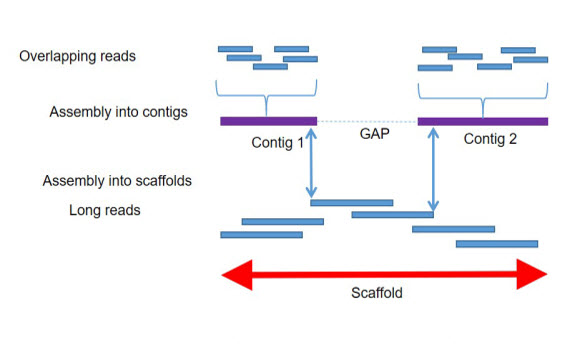
De novo Sequencing (Fig. 1)
De novo sequencing reconstructs an unknown genome without a prior reference database using a priori sequence assembly algorithms. Modern bioinformatics tools leverage sequence overlaps to generate highly continuous contigs. Where combining short and long reads (hybrid assembly) was once essential, the single-technology use of high-accuracy long reads now delivers direct, exceptionally accurate assemblies. These contigs are subsequently scaffolded into chromosome-scale, haplotype-phased assemblies (distinguishing maternal and paternal alleles) using chromatin conformation capture (Hi-C).
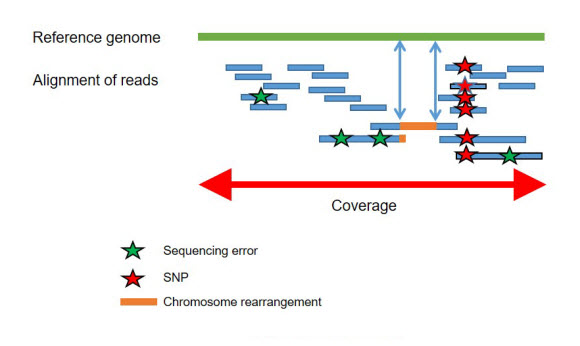
Resequencing and Variant Detection (Fig. 2)
The primary goal of resequencing previously cataloged genomes is to map single-nucleotide and structural variations and understand their functional impacts. Generated reads are aligned against a reference genome or modern reference pangenomes. While short-read sequencing remains cost-effective for single nucleotide polymorphisms (SNPs) and small insertions/deletions (indels), long reads have become the gold standard for accurately resolving complex structural variants (CNVs, inversions, translocations) and traversing highly repetitive genomic regions.
Key Technology Advances
The sequencing landscape is currently defined by several major technological developments:
- PacBio (Revio): Utilizing Circular Consensus Sequencing (CCS), PacBio platforms generate long reads (15 to 20 kb) known as HiFi (High-Fidelity) reads, achieving accuracy over 99.9%. This enables direct, precise, and affordable de novo assembly for large eukaryotic genomes.
- Oxford Nanopore Technologies (ONT): ONT platforms (MinION, PromethION) produce ultra-long reads (>1 Mb). Continuous improvements in chemistry and deep-learning basecallers have raised accuracy above 99%, unlocking the complete resolution of centromeric and heterochromatic regions (e.g., Telomere-to-Telomere / T2T initiatives).
- Native Epigenetic Profiling: Both PacBio and ONT platforms can now directly detect DNA base modifications (e.g., 5mC) during standard sequencing, bypassing the need for chemical bisulfite treatment.
- Scaffolding: Chromatin conformation capture (Hi-C) has established itself as the leading technology for chromosome-level scaffolding and phasing.